Choosing the right bed system is one of the most important decisions you’ll make when planning a campervan conversion. But once you’ve decided that a RIB bed is the right option for you, there’s another question to answer:
‘Which one do I get?‘
Firstly, What is a RIB bed system?
The RIB Altair is manufactured by Scopema and is designed to work as both a rear passenger seat and a campervan bed. Unlike a traditional Rock & Roll bed, the RIB uses a clever flip-over design. The seat and backrest transform into a flat sleeping surface, while the system can retain useful storage space behind and underneath the seat.
Scopema currently offers the two-seat Altaïr 3P in widths ranging from 860mm through to 1200mm, while its three-seat version is available in 1200mm, 1290mm, 1400mm and 1500mm widths. Sleeping length can also vary depending on the backrest configuration, with Scopema listing 1790mm, 1860mm and 1940mm options.
That means there’s more to choosing a RIB than simply deciding between a “small” and “large” bed. You need to consider both width and sleeping length, along with the number of people who need to travel in the rear and the amount of space you want to leave for the rest of your conversion.
RIB Bed Sizes
RIB systems are commonly referred to by their approximate width in centimetres. Depending on the exact model and configuration, you’ll commonly come across sizes such as 112cm, 120cm, 129/130cm and 150cm.
The most useful way to think about them is:
| RIB size | Typical configuration | Main advantage | Main consideration |
| 112cm | 2 seats | Leaves plenty of room for side furniture | Narrower sleeping surface |
| 120cm | 2 or 3 seats depending on configuration | Useful middle ground | Exact seating configuration needs checking |
| 130cm / 129cm | 3 seats | Wider bed while retaining some furniture space | Uses more interior width |
| 150cm | 3 seats | Maximum sleeping width | Significantly reduces space for side furniture |
These aren’t interchangeable configurations, and the exact specification matters. For example, Scopema’s current three-seat range includes both 1200mm and 1290mm versions, while 1400mm and 1500mm versions are also available.
At Templer Way, our conversion packages currently make use of 112cm and 130cm RIB Altair beds, with additional sizes and trim options available to discuss depending on the conversion.
So which one should you choose?

112cm RIB Bed: The Space-Saving Option
The 112cm RIB Altair is one of the most popular configurations for traditional campervan layouts, and there’s a good reason for that.
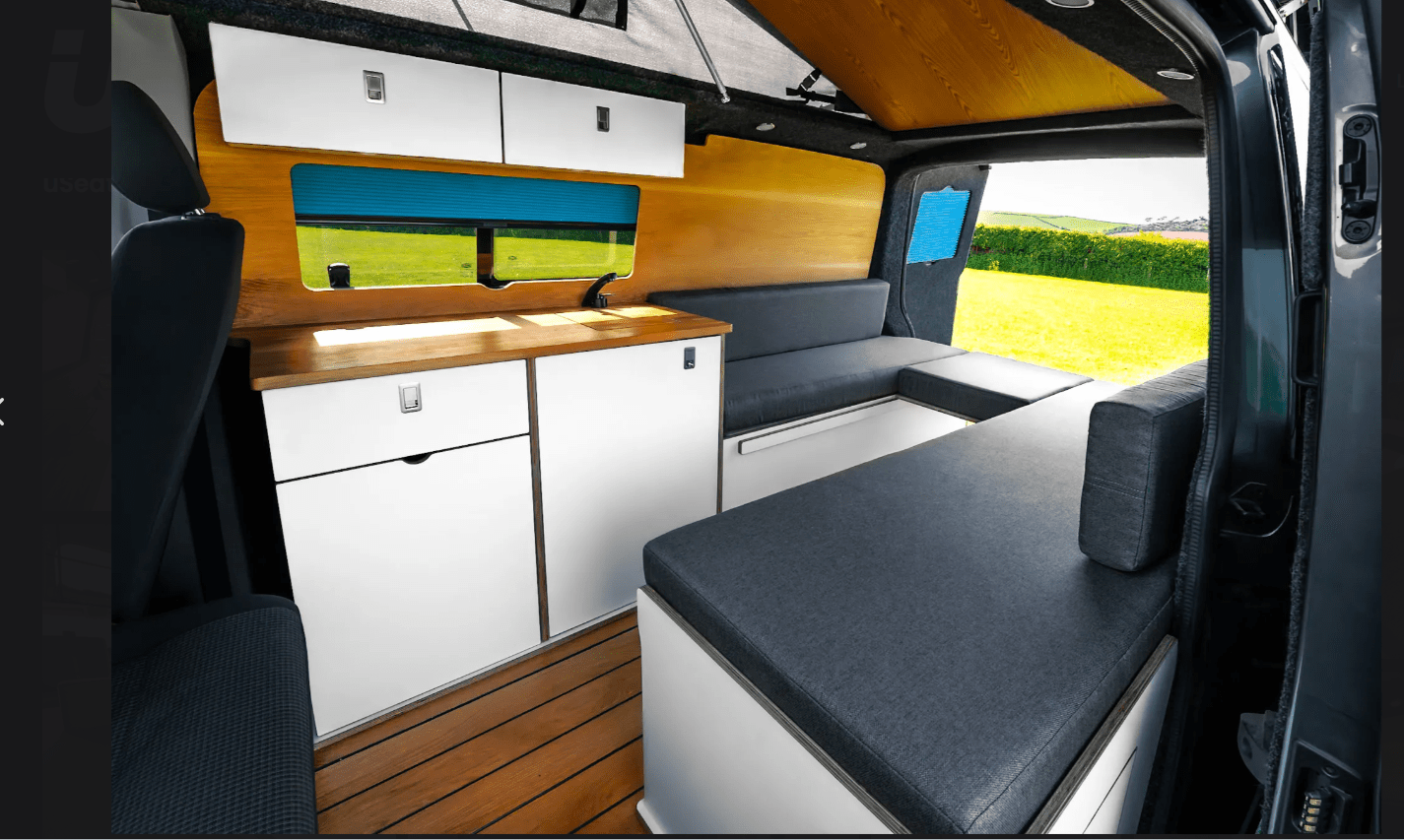
At 112cm wide, the bed provides a comfortable double sleeping area while leaving more room across the van for furniture. That extra space can make a significant difference when you’re trying to create a conventional campervan layout with a kitchen, cupboards and storage running alongside the bed.
Why Choose A 112cm RIB?
The biggest advantage is balance.
You get a proper RIB bed system without allowing the bed to dominate the entire width of the van.
This can give you room for:
- A side kitchen unit
- Cupboard storage
- A fridge
- Wardrobe or tall storage
- Additional rear storage
- A practical walkway
- Other furniture or equipment
This is one of the reasons we use the 112cm RIB Altair in several of our conversion packages. Our Bantham, Woolacombe and Saunton packages, for example, are built around a 112cm M1-tested RIB Altair bed.
What Is The Compromise?
The obvious compromise is bed width.
At 112cm, you’re not getting the same sleeping width as a 130cm or 150cm system.
For many couples, however, that trade-off makes sense. The bed is still wide enough to provide a practical sleeping area, while the additional room elsewhere in the van can make the conversion considerably more useful during the day.
If you’re planning to spend a lot of time inside the van, cook regularly and carry plenty of equipment, the space you save around the bed can be just as valuable as the extra centimetres of sleeping width.
120cm RIB Bed: The middle ground
A 120cm bed can provide a little more sleeping width than a 112cm system without taking up as much space as a full-width bed. In the right van and layout, that can make it an attractive compromise.
However, we wouldn’t recommend choosing a 120cm RIB based on the width alone.
Before ordering, you should establish:
- Whether you’re looking at a two- or three-seat configuration
- The exact sleeping dimensions
- The vehicle it’s being fitted into
- The furniture layout you want
- The frame and installation arrangement
- How much side space remains once everything is installed
The difference between a nominal 112cm and 120cm bed is only 8cm, but the overall layout can still change depending on how the furniture and seating are designed around it.

130cm RIB Bed: More Sleeping Space
The 130cm RIB is another option we use.
You’ll often see this referred to as a 129cm RIB in manufacturer specifications. Scopema lists the three-seat configuration at 1290mm, while UK suppliers commonly market it as a 130cm RIB.
This is an interesting middle ground.
Compared with a 112cm RIB, you’re gaining around 18cm of additional bed width. That can make the sleeping area feel noticeably more generous, while still leaving some scope for side furniture.
It’s particularly useful if you want:
- Three travelling seats
- A wider sleeping area
- A family-friendly layout
- More sleeping comfort
- Some side furniture and storage
The trade-off is that you’re using more of the van’s interior width for the bed.
Our current conversion packages include both 112cm and 130cm RIB Altair configurations, which means we can design the rest of the conversion around the bed size rather than treating the bed as an afterthought.
Full-width RIB beds: Maximum Comfort
At the other end of the scale is the 150cm full-width RIB.
As the name suggests, this takes up substantially more of the available width of the van.
The obvious advantage is sleeping comfort. A 150cm bed gives you a much more generous sleeping surface, approaching the width of a conventional double bed.
But there is a significant trade-off.
How It Changes Your Layout
When you move towards a full-width bed, you’re giving up some of the space that could otherwise be used for side furniture.
That means a 150cm RIB isn’t necessarily the “best” version of a RIB bed. It’s the right version for a particular type of conversion.
It can make sense if your priorities are:
- Maximum sleeping comfort
- A large bed
- A day van
- Carrying fewer built-in kitchen facilities
- Flexible open space
- Using portable cooking equipment
- Having a large seating/lounge area
A 150cm RIB can be less suitable if your ideal campervan includes a conventional side kitchen, large cupboards and lots of built-in storage.
That’s the important point to remember:
The wider the bed becomes, the more of your interior width it consumes.
Scopema’s current 1500mm Altaïr is a three-seat configuration, and UK conversion specialists commonly use this type of system where maximum bed width is more important than retaining conventional side furniture.
How RIB Bed Size Affects Your Kitchen
This is one of the biggest things to consider before choosing your bed.
A campervan isn’t just somewhere to sleep. For most people, you’ll also want somewhere to:
- Prepare food
- Store clothes
- Keep camping equipment
- Store electrical equipment
- Make drinks
- Keep a fridge
- Organise everyday essentials
All of that needs somewhere to go.
With a narrower RIB such as the 112cm configuration, you have more width available for side units. This makes a traditional campervan layout with a kitchen alongside the bed much easier to achieve.
As you move towards a 130cm or 150cm system, that available width becomes increasingly limited.
This doesn’t mean a wider RIB makes a kitchen impossible. It simply means the kitchen and furniture need to be designed around the bed from the beginning.
That’s why we recommend deciding on your bed system before finalising your furniture layout, rather than choosing your furniture first and trying to squeeze the bed into whatever space is left.
RIB Bed Size & Storage
Storage is another area where the difference between bed sizes becomes important.
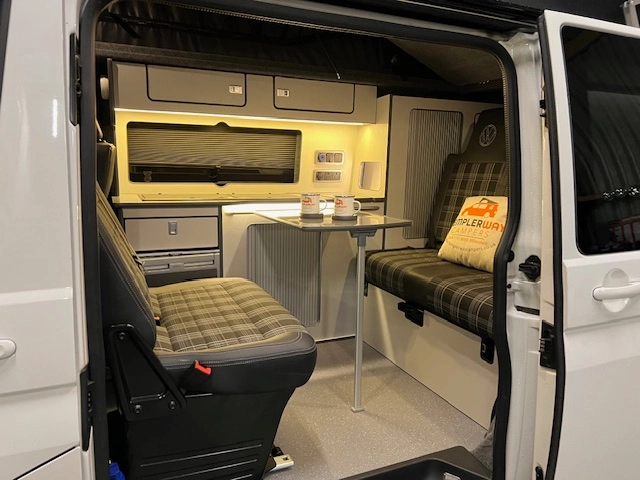
One of the advantages of the RIB Altair is that the design gives you useful storage options around and behind the seating system. The rear cushion can be positioned as a parcel shelf or moved upright when you need to carry larger items.
That can be particularly useful if you regularly carry:
- Bikes
- Camping equipment
- Sports equipment
- Outdoor furniture
- Large bags
- Family equipment
But the bed itself isn’t the only thing determining how much storage you have.
The width of the bed affects how much space remains for cupboards and other storage elsewhere in the van.
A 112cm RIB can therefore make sense for someone who wants a more complete built-in camper layout, while a wider bed might suit someone who prefers a more open interior and uses the van primarily for sleeping and carrying equipment.
How Many People Need To Travel?
This is something we recommend deciding before choosing the bed size.
A RIB bed is also a travelling seat, so passenger capacity isn’t something you should leave until the end of the conversion. If you’re travelling as a couple, a two-seat RIB may give you all the rear seating you need.
If you’re travelling with children, however, you may want additional rear travelling seats. That can change which RIB configurations are suitable. Scopema’s three-seat Altaïr systems incorporate three-point seatbelts, with ISOFIX/top-tether provisions depending on the width and configuration.
The important thing is to look at the specific bed and seating configuration, rather than assuming that a particular width automatically means a certain number of passengers. If you’re converting a Kombi, it’s also worth discussing what you’re doing with the existing rear seating before you choose your bed.
So, Which RIB Bed Size Is Right For You?
There isn’t one answer that works for everyone. Instead, start with how you intend to use the van.
A 112cm RIB could be right for you if:
- You’re travelling mainly as a couple
- You want a conventional campervan layout
- You want a kitchen alongside the bed
- Built-in storage is important
- You want to retain useful floor space
- You regularly carry camping or outdoor equipment
- You want a good balance between sleeping and living space
A 120cm RIB could be right for you if:
- You want a little more bed width
- Your layout can accommodate the additional width
- You’re considering a two- or three-seat configuration
- You want a compromise between sleeping space and furniture
Just make sure you’re comparing the exact 120cm configuration you’re considering, as the seating specification can differ.
A 130cm RIB could be right for you if:
- You want a wider sleeping area
- You need three rear travelling seats
- You’re travelling as a family
- You still want some side furniture
- You’re prepared to sacrifice some interior width for the larger bed
A full-width RIB could be right for you if:
- Sleeping comfort is your highest priority
- You want the largest possible bed
- You’re building a day van
- You don’t need a conventional side kitchen
- You value open space over built-in furniture
- You want a large, flexible sleeping/lounge area
If you’re looking for a deeper insight into how to choose the right bed system for your campervan, then we’ve got you covered